

Category: Software Engineering
The 10x Engineer and Delegated Responsibility
Whenever I do an introductory phone call with an engineering candidate, I make sure to explain my management style and how my approach directs our team’s process. Our process is agile, but it is decidedly not a formal Agile methodology. It’s not Agile Scrum; it’s not Extreme Programming; it’s not Kanban. Instead, it’s delegated responsibility in a culture of continuous deployment. I delegate the responsibility of something important to an employee–usually in the form of a significant feature–and let them take it from concept through implementation to deployment.
One of our co-founders serves as our product manager, and we have an experience design team that translates spoken words into diagrams and pictures. However, I make it very clear to my team that any text or visual content they receive are merely representations of product vision. We need them to guide us from here to there. The people on the front-lines–the ones doing the actual building of code and product–are the ones most equipped with information. They face the real constraints of the problem domain and existing code base; they have the best insights into how we can be most economical with their time; and they have the capacity to see all the options before us. I’m there to help them sift through that information, when needed, and to be that supportive coach, but my goal is for them to be carrying us forward. I manage, but I aim to lead, not micro manage.
Delegated responsibility is a very common and efficient practice in the business world. However, the practice has largely been abandoned in the software industry by practices and processes that shift responsibility onto a team of replaceable cogs. The team is expected to churn through a backlog of dozens of insignificantly small bits of larger features, which often lack foresight into the constraints that will be discovered and the interdepencies between smaller bits that result in developer deadlock. On top of this, a generalized backlog of small pieces creates room for misinterpretation by omitting full context around features or results in excessive communication overhead (see The Mythical Man Month).
We are most definitely inspired by Agile. We build a minimum viable product iteratively. We build-measure-learn, pair program when needed, collaborate, peer review each step of the way, and let our QA engineer find our leaky parts. However, my team members are individually responsible for their work and ship whenever they have something ready to show the world.
Some candidates would much rather be working on a team with equally-shared responsibility, collective code ownership, and continuous pair programming. I realize some people need this model, which is why I always discuss it with potential hires. However, others thrive with delegated responsibility. They take ownership, require little to no management or direction, make the right decisions, take pride in what they have built with their own two hands, and are extremely productive. Not surprisingly, others understand their code. It integrates well with the code base. They avoid the dangers that formal methodologies try to curtail. Often they are, or are becoming, that 10x developer. They are liberated, thrilled, and at their best working in this environment. It’s a joy to provide it to them.
If this sort of environment sounds exciting to you, please check out our careers page at LearnZillion.
Document the Why
Like many coders, I am a proponent of writing self-documenting code. The more I have worked with intentional code that omits unnecessary or misleading comments, the more efficient I have been as a software engineer. I read clear code and I understand what is going on.
However, regardless of whether I have spelunked self-documenting code or code with a girth of extraneous comments, both styles often omit why something is being done when it’s not obvious. Maybe an API you’re interacting with has a bug, so you have to do things in a roundabout or undocumented way. Maybe there is a non-obvious edge case that your main conditional branch code covers that another programmer would expect to be solved in a more conventional manner. Maybe you made a calculated business decision for a particular user experience when other sites behave differently.
Make it obvious why a non-obvious approach was taken. Save your fellow engineers and your future self from re-exploring the explored, re-arguing the argued, and re-deciding the decided.
Pivotal Tracker Dashboard
UPDATE: The script I wrote is no longer needed for the latest release of Pivotal Tracker, as pinned panes persist between browser refreshes. The script below is for the last release of classic Pivotal Tracker on June 20, 2013.
I like Pivotal Tracker. It’s a step-up from the cumbersome ticket tracking systems I’ve used in the past. As a manager though, it’s too cumbersome to see how my individual team members are doing and get an overall picture of how the team is doing at the same time. I’m only given a single backlog, which intermingles everyone’s tickets. I can see all tickets for a single engineer by using search, and I can pin each search results panel to get what I want. But if I reload the page, I lose all my efforts to build a usable dashboard. This is what I’m aiming for but without the hassle: a view of our current sprint (column one), our backlog (column two), our icebox (column three), and each engineer’s backlog (the remaining columns).
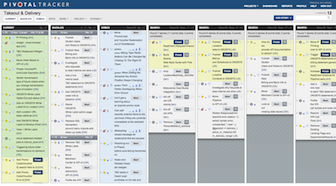
Yeah, the screenshot is a bit small here, but I’m not allowed to show you what we’re working on. With a little TamperMonkey grease, you too can have a comprehensive, and persistent dashboard. (GreaseMonkey if you’re still using Firefox.) Here is the script to pull it off. All you have to do is customize the project number and list of engineer name abbreviations.
// ==UserScript==
// @name       Pivot Tracker Dashboard
// @namespace  https://www.pivotaltracker.com/s/projects/
// @version    1.0
// @description  Show Pivotal Tracker panels for each engineer
// @match      https://www.pivotaltracker.com/s/projects/453961
// @copyright  2012, Ian Lotinsky
// ==/UserScript==
function main() {
  setTimeout(function() {
    var devs = 'mms, ay, hkb, bh, js, jw, np'.split(', ');
    for (i = 0; i < devs.length; i++) {
      $('.search .std').attr('value', 'mywork:' + devs[i]);
      $('#search_button').click();
      $('.pin_search').last().click();
    }
    $('searchString').clear();
  }, 2000);
}

// Source: http://stackoverflow.com/questions/2303147/injecting-js-functions-into-the-page-from-a-greasemonkey-script-on-chrome
var script = document.createElement('script');
script.appendChild(document.createTextNode('('+ main +')();'));
(document.body || document.head || document.documentElement).appendChild(script);
Now, this is a bit of hack, so not everything is roses. You still have to move tickets around in the standard backlog and icebox; you can’t move tickets around inside the developer backlogs since they’re just pinned, search result panels; and you need to refresh your browser from time-to-time to refresh the developer backlogs. It’s not as smooth as a first-class feature, but it gets the job done.
Team Debt
I’m currently having a blast leading the technical team behind the LivingSocial Takeout & Delivery web site. One of the challenges of a growing team is maintaining appropriate amounts of communication. You want everyone to know everything that’s important, but not everything. Otherwise, you end up being a case study in The Mythical Man Month.
Although our team did not follow this plan when it was ramping-up, hindsight reveals the need for a team debt management strategy as it grows. After mulling over it for awhile, I’m fairly sure that if I lead a new team in the future, we will follow this path:
First engineer to join the team
- Sets-up the source code repository
- Writes a starter project README
- Provisions the application and team notification email addresses
- Wires-up application notification email(s)
Second engineer
- Sets-up the continuous integration (CI) server
- Provisions the CI notification email address(es)
- Wires-up CI notification emails
Third engineer
- Sets-up the team’s Campfire
- Wires-up commit and deployment notifications (Campfire and/or email)
Fourth engineer
- Sets-up a scrubbed production database dump that engineers can use for local development
What tech team debt tools do you typically employ, and when do you employ them?
 Ian Lotinsky